

One of the most common questions we hear from agricultural and irrigation professionals is whether to choose a submersible pump or a surface pump. The answer almost always comes down to one fundamental factor: where your water source is located in relation to the pump. Neither type is inherently "better"-they are designed for different jobs, and choosing the wrong one is the most common reason a pump underperforms or fails prematurely.
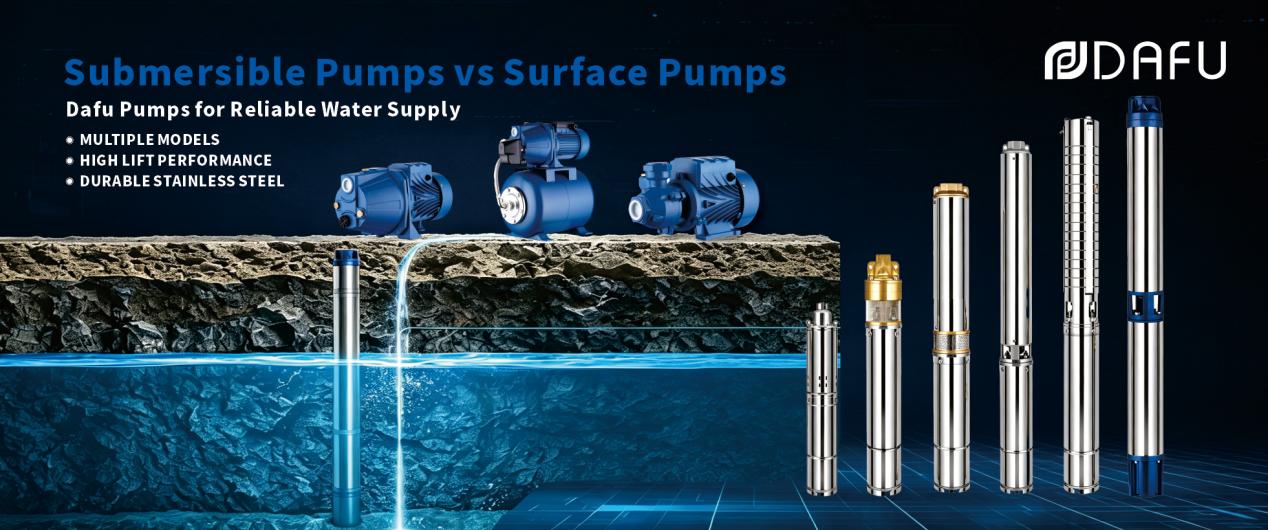
Understanding Surface Pumps
Surface pumps-also known as centrifugal or self-priming pumps-sit above the water level and draw water upward through a suction pipe. They work best when the static suction lift is 25 feet (approximately 7.6 meters) or less. In practice, most surface pumps can reliably lift water from a maximum depth of about 7 to 8 meters, regardless of motor power.
Advantages of Surface Pumps:
Easy maintenance access –The pump stays dry and accessible, making repairs and routine service straightforward
Lower initial cost – Surface pumps are generally more affordable than submersible pumps of comparable capacity
Multiple power options – Available in both electric and diesel-driven configurations, ideal for remote areas without grid power
High flow capacity – Large surface pumps can achieve flow rates of 20,000 GPM or more, making them ideal for high-volume applications
Limitations of Surface Pumps:
Limited suction lift – Cannot draw water from depths exceeding approximately 25 feet
Priming required – Suction leaks or air ingress can cause loss of prime, stopping water flow
Larger footprint – Surface pumps and their associated hoses occupy significant space and can interfere with other equipment
Cavitation risk –In warm climates or when water levels drop, cavitation can occur, causing noise and potential pump damage
Understanding Submersible Pumps
Submersible pumps are designed to operate fully submerged in the water source. The motor is close-coupled to the pump body and is cooled by the surrounding water, which leads to lower operating temperatures and higher motor efficiency. Because submersible pumps push water upward rather than pulling it, they do not face the suction lift limitations that restrict surface pumps.
Advantages of Submersible Pumps:
No suction lift limits – Can pump from deep wells, boreholes, and other sources where surface pumps cannot reach
Quieter operation – The pump is underwater, so there is minimal above-ground noise
Compact footprint – Occupies minimal surface space, ideal for sites with limited real estate
No priming needed – Since the pump is already submerged, there is no risk of losing prime
Superior cooling – Water cooling extends motor life and maintains stable operating temperatures
Limitations of Submersible Pumps:
Higher initial cost – Submersible pumps typically cost significantly more than surface pumps of comparable capacity
Maintenance complexity – The pump must be physically lifted out of the water for servicing or repairs
Electricity dependent – Most submersible options require electrical power; diesel-driven alternatives are rare
Seal integrity critical – Cable and seal quality are essential to prevent water ingress and motor failure
How to Make the Right Choice
When deciding between a submersible and a surface pump, ask yourself these four questions:
1. How deep is your water source?
If your water sits more than 25 feet (≈7.6 meters) below the pump location, a surface pump simply will not work. You need a submersible pump. For shallow wells, ponds, tanks, or streams where the water is within 25 feet of the surface, a surface pump is a viable and cost-effective option.
2. How much space do you have?
Surface pumps require a significant footprint for the pump unit and hoses. If space is limited or the site is congested, a submersible pump's compact design offers a clear advantage.
3. What is your maintenance capacity?
Surface pumps are easier and cheaper to service because they remain accessible. Submersible pumps require specialized lifting equipment for retrieval, which can increase downtime and maintenance costs.
4. What power source is available?
If you need a diesel-driven pump for a remote site without reliable electricity, a surface pump is your only practical option. If grid power or solar power is available, a submersible pump can deliver excellent efficiency and reliability.
A Note on High-Flow Applications
For large-scale agricultural operations that require moving substantial volumes of water from deep sources, a high flow submersible well pump is often the ideal solution. These pumps are specifically engineered to handle demanding irrigation requirements, delivering both the head needed to lift water from depth and the flow rate required to cover extensive acreage--. Whether you are irrigating row crops, pastures, or orchards, a properly sized high flow submersible well pump can provide the reliable, continuous water supply that modern agriculture demands.
Summary Decision Guide
|
If your situation is... |
Choose... |
|
Water source deeper than 25ft |
Submersible Pump |
|
Water source shallower than 25ft |
Surface Pump |
|
Remote site without electricity |
Surface Pump (diesel) |
|
Limited surface space |
Submersible Pump |
|
High-volume irrigation from deep wells |
High Flow Submersible Well Pump |
|
Budget-conscious with shallow source |
Surface Pump |
|
Noise-sensitive environment |
Submersible Pump |
Final Thought
The choice between a submersible pump and a surface pump is not about which technology is "better"-it is about which one is right for your specific application. By carefully evaluating your water source depth, site constraints, power availability, and maintenance capabilities, you can select the pump that delivers the best balance of performance, efficiency, and total cost of ownership for your irrigation needs.
Contact DAFU today for expert advice, product specifications, and a quick quotation tailored to your project.