

As a centrifugal transfer pump supplier, I often get asked how to calculate the power required for these pumps. It's a crucial question because getting the power calculation right ensures the pump operates efficiently and effectively. In this blog post, I'll break down the process of calculating the power required for a centrifugal transfer pump in a way that's easy to understand.
Understanding the Basics of Centrifugal Transfer Pumps
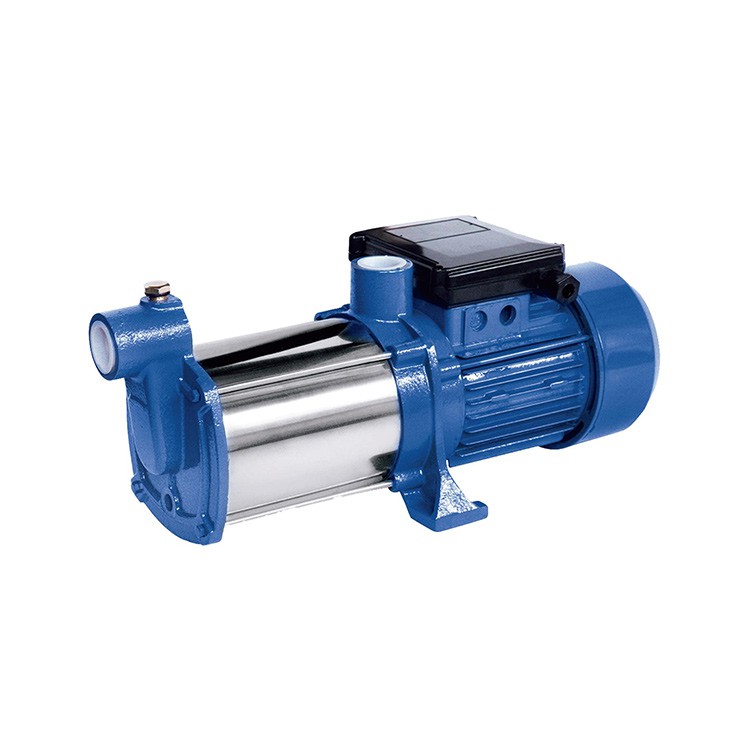
Before we dive into the power calculation, let's quickly go over what centrifugal transfer pumps are. These pumps work by using centrifugal force to move fluid. They have an impeller that rotates, creating a low - pressure zone at the center. This causes the fluid to be drawn in and then forced out at a higher pressure. There are different types of centrifugal pumps available, such as Centrifugal Force Water Pump, Centrifugal Pump for Home, High Pressure Centrifugal Water Pump, Centrifugal Pump Mini, and Multistage Centrifugal Pumps. Each type is designed for specific applications, but the basic principle remains the same.
Factors Affecting Power Requirement
Several factors come into play when calculating the power required for a centrifugal transfer pump.
Flow Rate (Q)
Flow rate is the volume of fluid that the pump needs to move per unit of time. It's usually measured in cubic meters per hour (m³/h) or gallons per minute (GPM). The higher the flow rate, the more power the pump will need. You can determine the required flow rate based on the specific application. For example, if you're using the pump for irrigation, you'll need to calculate how much water is needed to cover the area in a given time.
Head (H)
Head is the height or pressure that the pump needs to overcome to move the fluid. It includes the vertical distance the fluid needs to be lifted (static head), the pressure losses in the pipes due to friction (friction head), and any additional pressure requirements at the discharge point. Head is typically measured in meters (m) or feet (ft). A higher head means the pump has to work harder, thus requiring more power.
Fluid Density (ρ)
The density of the fluid being pumped also affects the power requirement. Denser fluids, like oil or some chemical solutions, require more power to move compared to less dense fluids like water. The density is usually measured in kilograms per cubic meter (kg/m³).
Pump Efficiency (η)
Pump efficiency is a measure of how well the pump converts the input power into useful work. No pump is 100% efficient, and there are always losses due to factors like friction in the impeller and bearings. The efficiency of a centrifugal pump is typically given as a percentage. A higher - efficiency pump will require less power to achieve the same flow rate and head compared to a less - efficient one.
The Power Calculation Formula
The formula to calculate the power required for a centrifugal transfer pump is:
[P=\frac{\rho\times g\times Q\times H}{\eta\times 3600}]

Where:
- (P) is the power required in kilowatts (kW)
- (\rho) is the density of the fluid in kilograms per cubic meter (kg/m³)
- (g) is the acceleration due to gravity, which is approximately (9.81\ m/s^{2})
- (Q) is the flow rate in cubic meters per hour (m³/h)
- (H) is the head in meters (m)
- (\eta) is the pump efficiency as a decimal (e.g., if the efficiency is 80%, then (\eta = 0.8))
Let's break down the steps to use this formula:
Step 1: Determine the Values
First, you need to measure or estimate the values of (\rho), (Q), (H), and (\eta). For example, if you're pumping water, the density (\rho) is approximately (1000\ kg/m^{3}). You can use flow meters and pressure gauges to measure the flow rate (Q) and head (H). The pump efficiency (\eta) can usually be found in the pump's technical specifications provided by the manufacturer.
Step 2: Plug the Values into the Formula
Once you have the values, it's just a matter of substituting them into the formula. Let's say you have a flow rate (Q = 20\ m³/h), a head (H = 30\ m), a fluid density (\rho=1000\ kg/m³), and a pump efficiency (\eta = 0.7).
[P=\frac{1000\times9.81\times20\times30}{0.7\times3600}]
First, calculate the numerator: (1000\times9.81\times20\times30 = 5886000)
Then, calculate the denominator: (0.7\times3600 = 2520)
Finally, divide the numerator by the denominator: (P=\frac{5886000}{2520}\approx2336\ W) or (2.34\ kW)
Importance of Accurate Power Calculation
Getting the power calculation right is super important. If you choose a pump with too little power, it won't be able to achieve the required flow rate and head. This means it might not be able to do its job properly, like not supplying enough water for a large - scale irrigation system. On the other hand, if you choose a pump with too much power, you'll be wasting energy and money. The pump will consume more electricity than necessary, and it might also cause unnecessary wear and tear on the pump components.
Tips for Choosing the Right Pump
- Understand Your Application: Know the specific requirements of your application, such as the type of fluid, the required flow rate, and the head.
- Consider Future Expansion: If you think your system might need to expand in the future, it's a good idea to choose a pump that has some extra capacity.
- Check the Pump's Efficiency: Look for pumps with high efficiency ratings to save on energy costs in the long run.
Let's Talk Business
If you're in the market for a centrifugal transfer pump and need help with calculating the power requirements or choosing the right pump for your application, I'm here to assist. Whether you're looking for a Centrifugal Force Water Pump, a Centrifugal Pump for Home, or any other type of centrifugal pump, I can provide you with expert advice and high - quality products. Don't hesitate to reach out for a consultation and let's discuss how we can meet your pumping needs.
References
- "Pump Handbook" by Igor J. Karassik et al.
- Technical manuals from various centrifugal pump manufacturers.