

Hey there, folks! As a supplier of centrifugal pumps, I often get asked about how to calculate the Net Positive Suction Head (NPSH) of a centrifugal pump. It's a crucial topic, and getting it right can make or break the performance of your pump. So, let's dive right in and break it down step by step.
First off, what the heck is NPSH? Well, NPSH is the measure of the pressure available at the suction inlet of a centrifugal pump to prevent cavitation. Cavitation is like the enemy of your pump. It happens when the pressure at the suction side drops below the vapor pressure of the liquid, causing vapor bubbles to form. These bubbles then collapse when they reach higher-pressure areas inside the pump, creating shockwaves that can damage the impeller, casing, and other components over time. So, you definitely want to avoid it!
There are two types of NPSH that you need to understand: NPSH Available (NPSHA) and NPSH Required (NPSHR).
NPSH Available (NPSHA)
NPSHA is all about the system conditions on the suction side of the pump. It's the actual net positive suction head that the system provides to the pump. To calculate NPSHA, you'll need to consider several factors.
-
Atmospheric Pressure ($P_{atm}$):
The atmospheric pressure varies depending on your location and altitude. At sea level, it's approximately 101.3 kPa (14.7 psi). You can look up the specific atmospheric pressure for your area using online tools or weather stations. -
Static Suction Head ($h_s$) or Static Suction Lift ($h_l$):
If the liquid source is above the pump centerline, you have a static suction head. If it's below, you have a static suction lift. Measure the vertical distance in feet or meters. A positive value for $h_s$ adds to the NPSHA, while a positive value for $h_l$ subtracts from it. -
Friction Loss ($h_f$):
As the liquid flows through the suction piping, valves, and fittings, there's friction that causes a pressure drop. You can calculate the friction loss using the Darcy - Weisbach equation or use the manufacturer's data for the piping and fittings. The friction loss always subtracts from the NPSHA. -
Vapor Pressure of the Liquid ($P_v$):
The vapor pressure of the liquid depends on its temperature. You can find vapor pressure tables for different liquids at various temperatures. The vapor pressure subtracts from the NPSHA because it represents the pressure at which the liquid starts to vaporize.
The formula for calculating NPSHA is:
[NPSHA=\frac{P_{atm}}{\rho g}+h_s - h_l - h_f-\frac{P_v}{\rho g}]
where $\rho$ is the density of the liquid, $g$ is the acceleration due to gravity.
Let's say you're using our Centrifugal Pump for Hot Water and you want to calculate the NPSHA. You've got an atmospheric pressure of 100 kPa, a static suction head of 5 meters, a friction loss of 1 meter, and the vapor pressure of the hot water at the given temperature is 20 kPa. The density of water is approximately 1000 kg/m³, and $g = 9.81 m/s²$.
First, convert the pressures to head:
[ \frac{P_{atm}}{\rho g}=\frac{100\times1000}{1000\times9.81}\approx 10.2 m]
[ \frac{P_v}{\rho g}=\frac{20\times1000}{1000\times9.81}\approx 2.04 m]
Then, calculate NPSHA:
[NPSHA = 10.2+5 - 1 - 2.04=12.16 m]
NPSH Required (NPSHR)
NPSHR is determined by the pump manufacturer. It's the minimum NPSH that the pump needs to operate without cavitation. The manufacturer conducts tests to find out how much pressure is required at the suction inlet to keep the pump running smoothly.
You can usually find the NPSHR curve in the pump's performance data sheet. This curve shows how the NPSHR changes with the flow rate. As the flow rate increases, the NPSHR generally increases too.
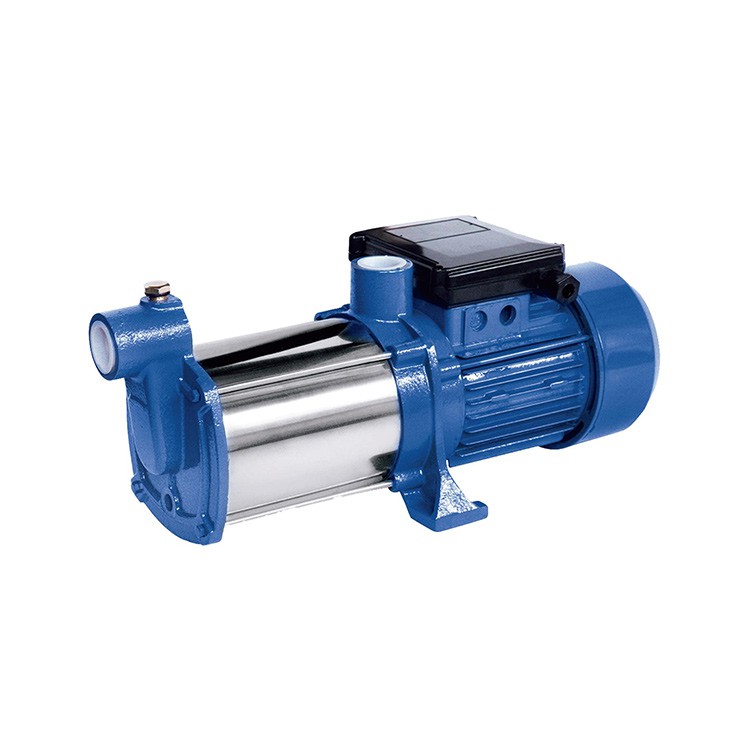
For example, if you're looking at our Multistage Centrifugal Pumps, the NPSHR values will be provided in the product documentation. You need to make sure that your calculated NPSHA is greater than the NPSHR at the desired flow rate. A good rule of thumb is to have a margin of at least 0.5 - 1 meter (1.5 - 3 feet) between NPSHA and NPSHR to ensure reliable operation.
Why is NPSH Calculation So Important?
Getting the NPSH calculation right is super important for a few reasons.

-
Prevent Cavitation: As I mentioned earlier, cavitation can cause serious damage to your pump. By ensuring that NPSHA > NPSHR, you can avoid the formation of vapor bubbles and the resulting damage.
-
Optimal Performance: A pump that operates with sufficient NPSH will have better efficiency and performance. It will run smoothly, without excessive noise or vibration, and will deliver the expected flow rate and head.
-
Longevity: When a pump is operating without cavitation, its components will last longer. You'll save on maintenance and replacement costs in the long run.
How We Can Help
We're a leading supplier of centrifugal pumps, and we've got a wide range of options to suit your needs. Whether you're looking for a Standard Centrifugal Pumps for a simple application or a more specialized pump for a challenging project, we've got you covered.
Our team of experts is always available to help you with NPSH calculations and pump selection. We can work with you to understand your system requirements, analyze the NPSH conditions, and recommend the best pump for your application. We'll also provide you with all the technical support you need to ensure that your pump operates at its best.
If you're in the market for a centrifugal pump or need help with NPSH calculations, don't hesitate to reach out. We're here to make the process as easy and stress - free as possible for you. Contact us today to start the conversation and let's find the perfect pump for your project.
References
- "Pump Handbook" by Igor J. Karassik, Joseph P. Messina, Paul Cooper, and Charles C. Heald.
- "Fluid Mechanics" by Frank M. White.